
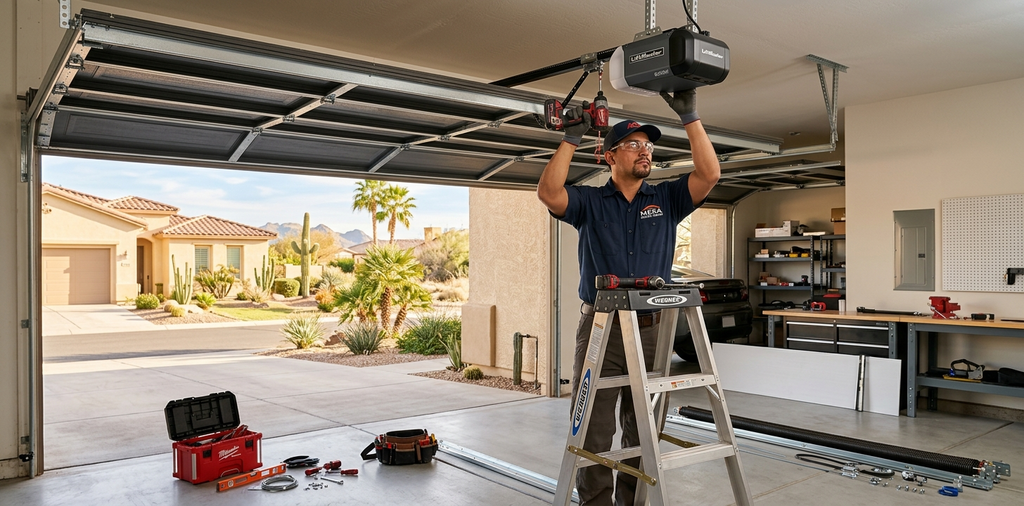
A new opener should make arriving home easier, not create a new set of worries. When your current unit grinds, stops halfway, ignores the remote, or lacks modern safety features, a professional replacement can restore dependable access without putting extra strain on the garage door itself.
For homeowners who need garage door opener installation mesa service, the right solution starts with more than choosing a motor. We look at the door’s balance, weight, tracks, springs, headroom, power source, and safety equipment, then match the opener to the system so it operates smoothly day after day.
What A Proper Opener Installation Should Include
A garage door opener is only one part of a larger moving system. If the door is heavy, binding, off balance, or traveling unevenly, even a powerful new unit can wear out early. That’s why the best installation begins with a full door inspection, not just mounting a motor to the ceiling.
| Installation Step | Why It Matters | What We Check |
|---|---|---|
| Door balance | Protects the new opener | Springs, lift force, travel |
| Opener selection | Fits your home and door | Drive type, power, features |
| Safety setup | Helps prevent closing hazards | Sensors, reversal, wall control |
| Final testing | Confirms reliable operation | Limits, remotes, smooth movement |
The garage door must be balanced first
A properly balanced garage door should stay in place when manually positioned partway open. If it drops, feels unusually heavy, or sticks in the tracks, the opener is not the problem alone. It may be compensating for worn rollers, cable trouble, damaged tracks, or a spring issue.
The U.S. Consumer Product Safety Commission advises that a garage door that binds, sticks, or is not balanced should be serviced by a professional. It also recommends checking the opener and door every 30 days. Read the CPSC garage door safety guidance.
Safety sensors and reversal testing are not optional details
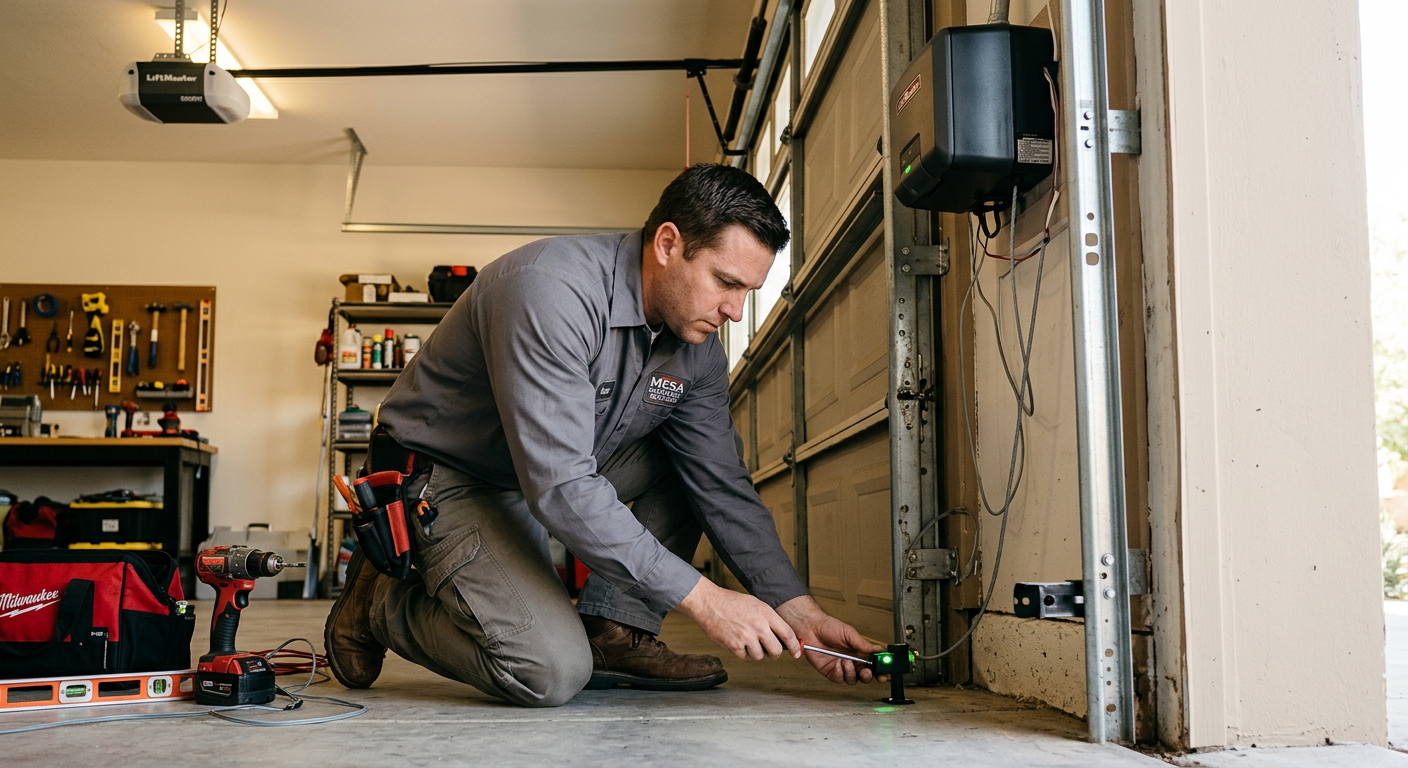
Modern openers use photo-eye sensors near the floor and an automatic reversing system. The sensors need correct placement, secure mounting, clear alignment, and protected wiring. We also set travel limits and test the door’s reversal function before calling the job complete.
This matters because federal consumer safety standards require automatic residential garage door operators to include entrapment protection. A new opener installation is the right time to replace unreliable sensors, old controls, and worn components that affect safe daily use.
Choosing The Right Garage Door Opener For Your Mesa Home
There is no single best opener for every household. The right choice depends on the door’s size, construction, how often you use it, whether bedrooms sit above the garage, and the features you value most.
Belt-drive openers for quieter operation
A belt-drive opener is a strong fit when the garage is close to living spaces. Its reinforced belt typically runs more quietly than a chain system, which can make early departures and late arrivals less disruptive.
Chain-drive openers for straightforward durability
Chain-drive systems remain a practical option for many standard residential doors. They can be noisier, but a correctly matched and installed chain-drive unit is dependable and easy to maintain.
Wall-mount openers for ceiling space
A wall-mount or jackshaft opener attaches beside the garage door instead of hanging from the ceiling. It can be helpful in garages with high ceilings, storage racks, or a layout where you want the ceiling area open. The door and torsion system must be compatible, so an on-site evaluation is important.
Useful features that solve real problems
We encourage Mesa homeowners to focus on practical features instead of buying based on marketing alone. Depending on your needs, that may include battery backup during outages, keypad access for family members, smartphone control, motion-activated lighting, or a quieter motor.
If the existing system sometimes works but has become inconsistent, a repair may still be worthwhile. Our garage door opener repair service can identify whether the issue involves the motor, gear assembly, logic board, remote, wall control, sensors, or the garage door itself.
Signs It Is Time To Replace Your Garage Door Opener
Age alone does not automatically mean an opener needs replacement. Still, some symptoms point to an upgrade being the more sensible choice than repeated repairs.
- The opener hums but the door does not move.
- The door reverses randomly or will not close from the remote.
- Safety sensors repeatedly lose alignment or have damaged wiring.
- The unit makes loud grinding, popping, or rattling sounds.
- The motor runs but the chain, belt, or trolley does not move correctly.
- The opener has no reliable automatic reversal feature.
- You want battery backup, app control, or quieter operation.
Here’s the thing, a new opener cannot safely lift a door with a broken spring or serious track problem. If your door is crooked, unusually heavy, or has stopped moving altogether, ask for a broader garage door repair inspection before scheduling an opener replacement alone.
When To Call For Same-Day Help
Some opener issues are inconvenient. Others prevent you from getting your vehicle out, leaving your home unsecured, or closing the door safely at night. Call for prompt professional service if the door is stuck open, stuck closed, moving unevenly, hanging off track, or making a loud bang followed by failure to lift.
We serve Mesa and nearby East Valley communities with clear recommendations after inspecting the full system. If you need help deciding between repair and replacement, call GT Garage Door Repair at (602) 680-9700 for a free estimate and a practical answer based on what your door actually needs.
Why Professional Installation Protects Your Investment
A homeowner can find plenty of online videos showing opener installation. What those videos rarely account for is the condition of an individual door, the correct reinforcement point, local ceiling layout, sensor-wire routing, force settings, and the risks around springs and cables.
Professional installation helps prevent common problems such as excessive opener strain, a door that reverses at the floor, noisy travel, loose mounting hardware, intermittent remote operation, and sensors that stop working after a few weeks. We install the unit, program available controls, explain operation, and test the system with you before we leave.
For Mesa homeowners dealing with a garage door that has broader mechanical problems, our Mesa garage door repair services cover springs, cables, rollers, tracks, off-track doors, maintenance, and replacement planning as well.
Garage Door Opener Installation Mesa FAQs
How long does garage door opener installation take?
Most standard installations can be completed in one visit. Timing can vary when the door needs repairs first, ceiling supports need adjustment, wiring needs attention, or the existing opener must be removed from a difficult setup.
Can a new opener fix a garage door that is heavy?
No. A properly functioning opener guides the door, but the springs carry most of the door’s weight. If the door feels heavy when disconnected from the opener, the spring system should be inspected before installing a new motor.
Should we repair or replace an older garage door opener?
Repair is often a sensible choice for a newer unit with a specific issue, such as a failed remote, sensor alignment problem, worn gear, or damaged wall control. Replacement may make more sense when the unit is outdated, repeatedly unreliable, lacks important safety features, or needs costly major components.
Why does a garage door open but not close?
Photo-eye sensors are a common cause. Dirt, direct sunlight, loose wiring, or sensors that are out of alignment can interrupt the beam and prevent the door from closing normally. A damaged roller, track issue, or incorrect force setting can also be involved.
Do new garage door openers work during a power outage?
Only if the selected model has a battery backup feature and the battery is maintained. Without power or battery backup, you can usually use the manual release to operate a properly balanced door by hand.
Can we keep our existing remotes and keypad?
Sometimes, but compatibility depends on the opener brand, model, and age. During installation, we can program compatible remotes and keypads, then explain how to use the new controls.
How often should an opener be tested after installation?
Check the safety reversal function and photo-eye sensors monthly, following the manufacturer’s instructions. You should also watch for new noise, jerky travel, delayed response, or a door that no longer opens and closes evenly.
Schedule Reliable Garage Door Opener Service In Mesa
GT Garage Door Repair is a family-owned garage door company based in Chandler and serving Mesa, Gilbert, Tempe, Queen Creek, Ahwatukee, San Tan Valley, Sun Lakes, and surrounding East Valley communities. We provide opener installation, opener repair, spring and cable service, off-track repairs, maintenance, and residential garage door replacement with honest recommendations and professional workmanship.
When you need dependable garage door opener installation mesa service, call (602) 680-9700 or schedule garage door service online. We’ll inspect the door, explain the options clearly, and help you restore safe, dependable access to your home.
The Bottom Line
The right new garage door opener can make your home quieter, more convenient, and easier to secure. But the installation only performs as well as the door beneath it, so checking balance, springs, tracks, sensors, and final safety settings is essential.
If your current opener is unreliable or your garage door is putting your daily routine on hold, professional evaluation is the fastest way to get a solution that fits your home and avoids unnecessary repeat repairs.